1. Blog
  2. Article

Canonical
on 11 March 2015
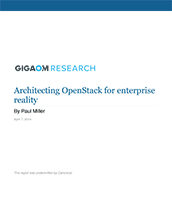
Architecting OpenStack for enterprise reality


With OpenStack becoming more and more popular as a cloud-building technology for enterprises, companies are asking themselves several important questions. How viable is OpenStack as an enterprise platform? Is it possible (and feasible) to integrate it with existing virtualisation infrastructure, e.g. vSphere from VMware? Is there a business case for such integration, and what are the risks and challenges associated with it? Finally, how do they best utilise OpenStack: is the “vanilla” architecture always the best approach, or is there a case for swapping out certain components for third-party tools?

Gigaom analyst Paul Miller looks at these questions and more in this report sponsored by Canonical. For a more in-depth look at integrating vSphere and OpenStack, you may also want to read this whitepaper.


Download eBook

Related posts


Canonical
23 April 2026

Canonical releases Ubuntu 26.04 LTS Resolute Raccoon

Cloud and server Article

The 11th long-term supported release of Ubuntu delivers deep silicon optimization and state-of-the-art security for enterprise workloads. ...


Samir Kamerkar
22 April 2026

From Jammy to Resolute: how Ubuntu’s toolchains have evolved

Ubuntu Article

We cover new toolchain versions, devpacks and workflows that improve the developer experience. The evolution of Ubuntu’s toolchains story goes beyond just providing up-to-date GCC, LLVM, and Python. It is also about opinionated openJDK variants, task-focused devpacks, FIPS compliant toolchains, and snaps, like the new .NET snap and Snapcr ...


Rob Gibbon
20 April 2026

Hybrid search and reranking: a deeper look at RAG

AI Article

Many of us are familiar with the retrieval augmented generative AI (RAG) pattern for building agentic AI applications – like digital concierges, frontline support chatbots and agents that can help with basic self-service troubleshooting.  At a high level, the flow for RAG is fairly clear – the user’s prompt is augmented with some relevant ...